
Why a £250K ISA won’t replace your salary – but could still transform your retirement


A £250,000 ISA sounds like a major financial milestone. But when it comes to replacing a salary, the reality is far more sobering than it first appears.
Thatâs because retirement outcomes arenât determined by how a portfolio was built. Theyâre determined by how much income it can sustainably provide once withdrawals begin.
Sustainable income
Once contributions stop, the maths becomes remarkably simple. A portfolio either supports a given level of inflation-adjusted income, or it doesnât â regardless of how long it took to get there.
The chart below focuses only on this drawdown phase. It assumes a cautious long-term return of 4% a year and inflation of 2%, and runs the portfolio down to zero by age 85. This effectively stress-tests the maximum sustainable income over a 20-year retirement.
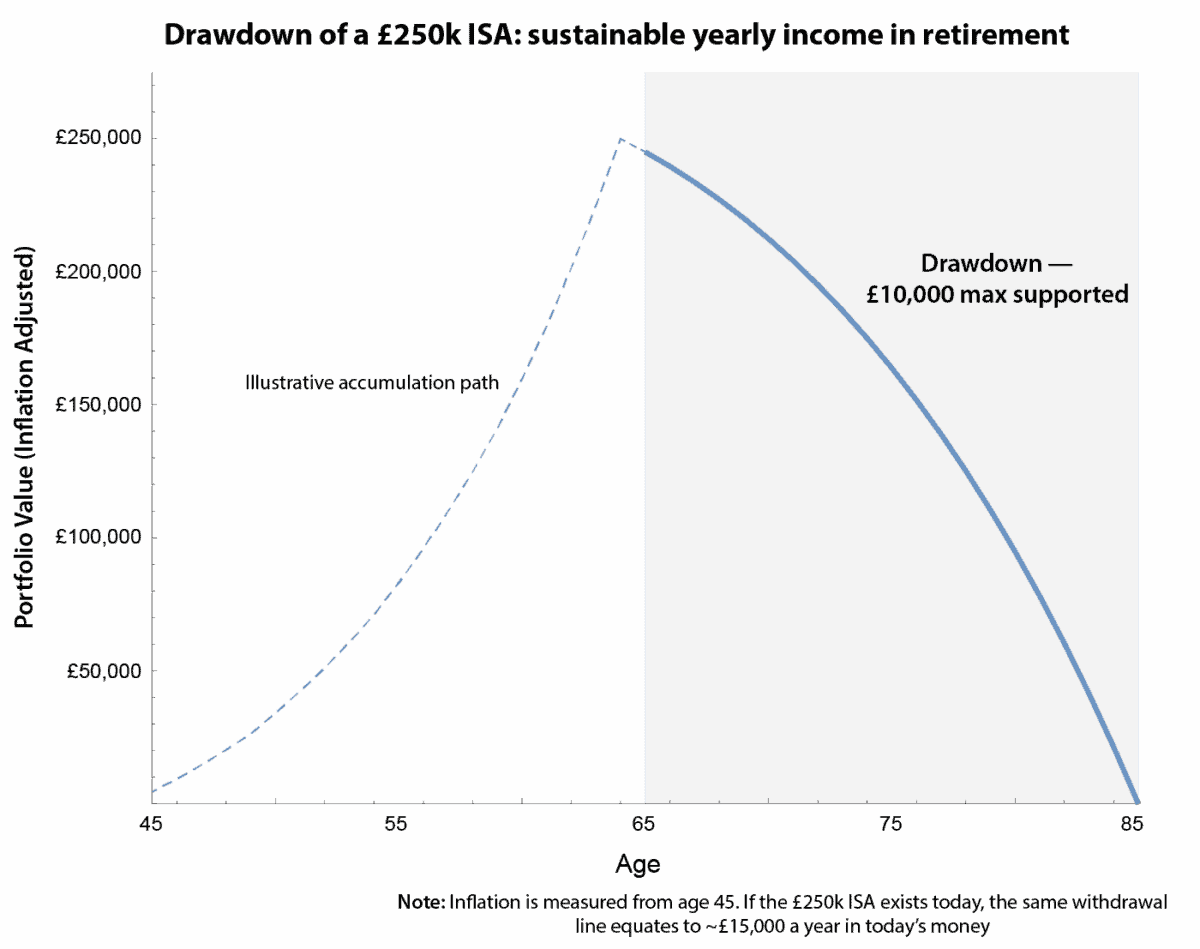
Chart generated by author
Under these assumptions, a £250,000 ISA can generate around £10,000 a year, or roughly £833 per month, in real terms. That may cover some essentials or supplement other income, but it falls well short of replacing a typical salary.
Allowing for market volatility or longer life expectancy reduces sustainable income to around £750 per month, while leaving a residual balance of roughly £57,000.
Inflation timing
Where investors often get confused is inflation. If you already hold the full £250,000 today, the starting capital is in place immediately, which supports income closer to £15,000 a year, or about £1,250 per month in todayâs money.
Crucially, this isnât a different withdrawal strategy. The sustainable income line in real terms is unchanged â having the capital today simply increases the equivalent income in todayâs money. Prior accumulation improves flexibility, but it doesnât change the underlying drawdown maths.
The message is clear: a £250,000 ISA is a solid foundation, but not life-changing on its own. Its real value lies in providing flexibility by supplementing pensions and spending, rather than fully replacing earned income.
A different way to look at Legal & General
When investors talk about income stocks, the focus is usually on yield. But with Legal & General (LSE: LGEN), the more interesting question is why that income exists â and why it keeps showing up year after year.
At its core, itâs a cash-recycling business. It takes in long-dated liabilities from pensions and annuities, invests against them conservatively, and steadily releases capital over time. That capital is then returned to shareholders through dividends and buybacks.
This matters whether youâre still building an ISA or already drawing income from one. During accumulation, reinvested dividends quietly do the heavy lifting. In drawdown, those same payments can reduce how much you need to sell â smoothing the journey through volatile markets.
What makes the shares stand out today is predictability. Management has committed to a modest 2% dividend growth, backed by long-term pension contracts rather than short-term market optimism. Itâs not exciting, but itâs deliberate â and thatâs often what income investors actually need.
Of course, it comes with risks. Sharp moves in bond yields, regulatory changes, or weaker capital generation could pressure dividends, while the high yield leaves little margin for operational missteps.
Bottom line
Legal & General isnât about maximising returns. Itâs designed to generate and return cash steadily over time, which could make the shares relevant across multiple stages of an investorâs journey. That long-term cash focus is why I own the shares.
The post Why a £250K ISA wonât replace your salary â but could still transform your retirement appeared first on The Motley Fool UK.
Should you invest £1,000 in Legal & General Group Plc right now?
When investing expert Mark Rogers has a stock tip, it can pay to listen. After all, the flagship Motley Fool Share Advisor newsletter he has run for nearly a decade has provided thousands of paying members with top stock recommendations from the UK and US markets.
And right now, Mark thinks there are 6 standout stocks that investors should consider buying. Want to see if Legal & General Group Plc made the list?
More reading
- How much would someone need in the stock market to earn a £500 weekly second income?
- Stocks and Shares ISA vs Cash ISA: how much to target a £10,000 passive income?
- An 8.6% yield? Here’s the dividend forecast for a FTSE 100 income hotshot
- 3 brilliant dividend shares to consider buying for 2026
- UK dividend shares: a once-in-a-decade shot at bagging these 3 ultra-high yields?
Andrew Mackie has positions in Legal & General Group Plc. The Motley Fool UK has no position in any of the shares mentioned. Views expressed on the companies mentioned in this article are those of the writer and therefore may differ from the official recommendations we make in our subscription services such as Share Advisor, Hidden Winners and Pro. Here at The Motley Fool we believe that considering a diverse range of insights makes us better investors.