
Archive

June 2026

Browsing

When the U.S. men’s national soccer team plays at home, its most loyal fans traditionally sit right behind a goal to cheer on the team or intimidate the opposition.

But when the Americans kick off a once-in-a-generation World Cup in Southern California next week, many of those die-hard supporters may be harder to hear because FIFA seated them in the “nose bleeds,” according to a major U.S. fan group.

“These are the worst tickets that I’ve ever seen out of the five World Cups I’ve been to,” American Outlaws President Brian Hexsel said in a phone interview.

FIFA’s World Cup ticketing rollout has faced withering criticism for months, particularly for its sky-high prices. There have also been allegations that some ticket buyers got worse seats than expected, sparking investigations in New York and New Jersey.

In the blowback, soccer’s global governing body announced a small allotment of $60 tickets for each of the tournament’s 104 matches.

FIFA didn’t immediately comment for this article.

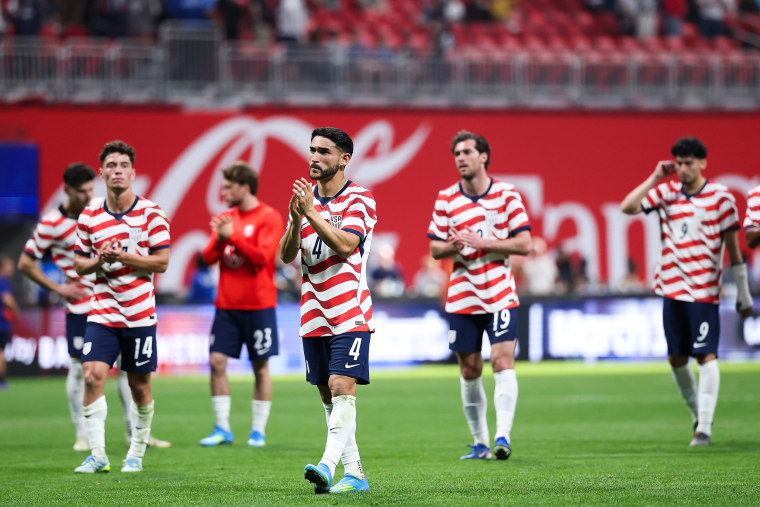
Cristian Roldan, center, and the U.S. team applaud fans after their loss to Belgium at Mercedes-Benz Stadium on March 28.Kevin C. Cox / Getty Images

Participating member associations, including U.S. Soccer, would manage “the selection and distribution process,” said FIFA, which emphasized it was asking the associations to “ensure that these tickets are specifically allocated to loyal fans who are closely connected to their national teams.”

The American Outlaws are such fans. The organization says it has more than 200 chapters worldwide sharing one goal: cheering on U.S. Soccer’s teams. The group travels to matches with hand-painted banners, a giant American flag, drums and organized chants — all of it typically on display right behind the net.

But this summer, American Outlaws members with $60 tickets will be in upper decks at each of the team’s three group stage matches, Hexsel said. That seating arrangement means some of the most fervent fans will be physically farther from the pitch, potentially making it harder for players to hear their shouts.

Hexsel said U.S. Soccer told him Monday that the $60 seats will be in sections 302 through 310 for the team’s first match against Paraguay at Los Angeles County’s SoFi Stadium, sections 310 through 315 in Seattle’s Lumen Field for the second match against Australia and section 426 for the third match back at SoFi against Turkey — putting fans even higher than they’d be seated for the first match.

U.S. Soccer told NBC News the $60 tickets are in sections 306 through 310 for the Paraguay match, sections 302 through 304 for the Australia match and sections 426 through 431 against Turkey. It didn’t provide further comment.

When the tickets started landing in people’s accounts Monday night, “my phone just blew up,” Hexsel said. “Everybody was pissed.”

It’s not clear whether fan groups for the World Cup’s other competing countries have been affected in the same way.

Juan Felipe Garay, coordinator of Colombia’s biggest supporters’ group, Fiebre Amarilla, told NBC News the group doesn’t yet know where its $60 seats will be for Colombia’s matches.

But Hexsel said that without question, for the American die-hards, a World Cup in their own backyard now “does not feel like we are playing in the U.S.”

South Florida superfan Burak, who asked that his last name not be published for privacy, told NBC News on Monday night that a ticket in the “400s” showed up in his account for the third U.S. match.

Burak said he laughed with his wife about the situation and hadn’t expected better seats. He prefers being high up at a match when he’s trying to “read the play.” But, he said, watching is secondary to making an impact when you’re in the supporters’ section.

“If you’re up at nosebleed 400s, your reaction doesn’t even matter. No one’s going to hear, see or notice,” he wrote in a text message.

Another U.S. fan, Gabriel Miguel, said, “I thought it could be worse.”

Miguel scored $60 tickets to the opening U.S. match against Paraguay. He’ll be in section 308 and said he’s “mostly grateful” just to be in the building.

“I would love to have been down in the lower action, but I mean, 300s is perfectly fine, especially for that price.”

American supporter Logan Pedersen said, “We could have been higher up … not by far.”

Pedersen said in a phone interview that he got “the golden ticket,” getting to see the opening U.S. match at such a relatively low cost. He’s “just glad to be in the stadium,” but he also said FIFA’s ticketing “process has been a nightmare.”

“It’s still super disappointing from FIFA that they’re not at least designating a section for, you know, 500 fans from each team directly behind the goal. I think it’s a huge loss for the atmosphere that’s gonna go on in the stadium,” he said.

Hexsel said of the seating arrangements, “It just means we gotta bring more drums and more noise to show the team that … we still showed up.”

“FIFA could have just said: ‘Hey … it’s 300, it’s 200. Yeah, it’s a little bit more than what you paid in Qatar, but you guys have a block of seats where you’ve always had a block of seats,’ and people would have paid it.”

Burak said by text message: “I’m just glad I can at least go to some games with the supporter price. I accept my small guy status. If we had a strong community, I’d be all about boycotting the WC all together. But that’s not how people are, that will never happen. And Fifa is feeding off of that. They know someone will show up.”

Said Miguel: “I’m happy to be going, at least, and it’s more like memories than anything. Could it be better? Of course. But … they dropped the ball from the beginning with this. It’s … nothing surprising at this point.”
Growing up in South Florida, Jozy Altidore heard a lot of Spanish playing soccer with local kids and at home from his Dominican grandmother. As a teenager, he went to play for Villarreal, in the Castellón part of Spain, an area that isn’t that touristy. His coach and teammates mostly spoke Spanish. Along the way, Altidore picked up the language.

“A lot of people look at me like, ‘What? You speak Spanish?’” Altidore told NBC News.

It will come in handy this summer, when Altidore serves as a World Cup commentator for Telemundo, the games’ official Spanish-language network. Altidore has no experience in broadcasting, and he admits that his Spanish is just OK. But he saw the World Cup was coming to North America, and he didn’t want to be left on the sidelines.

“It’s the biggest, most historical World Cup we’ve had,” Altidore said. “For me, it was a good opportunity to stay involved, be a part of the World Cup.”

But what about his Spanish? “I can get by,” he said. “I thought, ‘What a cool challenge.’ I think you want to challenge yourself, in the things that you’re doing, always.”

Plus, he’ll get to see the Telemundo broadcast up close, the excitement of it, which is a stark contrast to the English-language telecasts, particularly the “goal” calls from the announcer Andrés Cantor. “I always wondered, how does he do that in one breath?” Altidore said. “This guy goes just the whole time. I can’t wait to see the legend in action.” (Telemundo and NBC News share a parent company, NBCUniversal.)

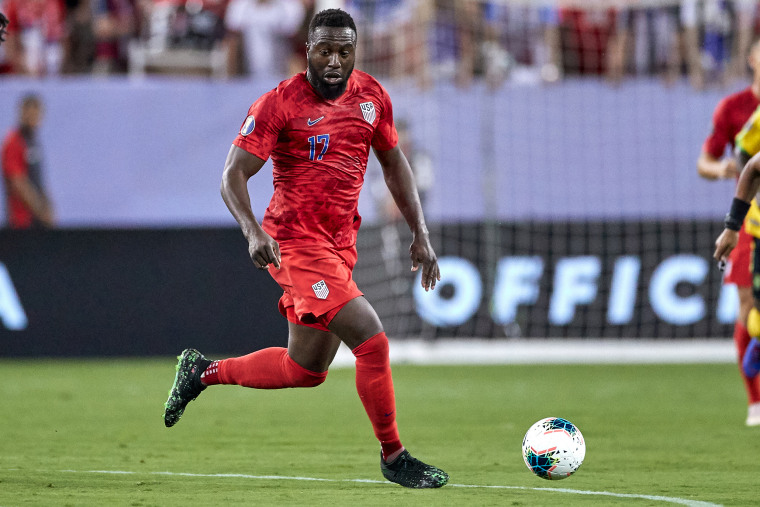
Altidore during the Gold Cup semifinal match between the U.S. and Jamaica in Nashville, Tenn., on July 3, 2019.Robin Alam / Icon Sportswire via Getty Images file

Altidore will be offering analysis and insight on Team USA’s games not far removed from his own time playing for the team. He is considered one of the best American players of the last two decades, a striker who scored 42 goals in 115 appearances. He helped the U.S. make it to the 2010 and 2014 World Cups, though he got injured during the latter tournament. He played with a few members of the 2026 roster, including Christian Pulisic.

Altidore told NBC News he has a rose-colored view of the current team. “I’m optimistic,” he said. “I’m bullish. I think this team can win the World Cup. I really do. I think they have the talent. And I’m so excited for them to get their flowers.”

Altidore understands how that sounds: Team USA? Winning the World Cup? But he pointed to past examples of host countries making deep runs in the tournament: South Korea reaching the semifinals in 2002, and Germany doing the same in 2006. Colombia also reached the quarterfinals in 2014, when the World Cup was held in neighboring Brazil.

With this World Cup being held on home soil, maybe “we’re able to push our team to a bit of a better performance than we have historically,” Altidore said.

He didn’t just mean the players — he meant the fans, too. “Can we show up in numbers in a way that, from the players’ arrival, they feel the emotion, they feel the enthusiasm, they feel the camaraderie?” Altidore said. “And we can push them on to play a little bit above themselves, to play a little bit above what we’ve seen already.”

You can sense his excitement. As a media member, Altidore will have to now learn to balance his rooting interests with offering clear-eyed analysis. “For me, it’s really getting behind these guys, applauding them for how far they’ve now taken the flag and where they’ve brought it,” he said. “But at the same time, it’s not all rainbows. You’ve got to be critical of guys, and you have to obviously critique their performances.”

Altidore was first introduced to soccer in 1994, the last time the U.S. hosted the World Cup, when he was just a young boy. His father recorded games on VHS tapes. He imagines lots of families will do the same this summer, three decades later, albeit with updated technology.

“They’re going to get exposed to soccer in a wonderful way for the first time, and it’s going to birth soccer players, it’s going to birth soccer fans, soccer enthusiasts,” Altidore said.

He’ll be doing his part, by showing his enthusiasm on the Telemundo broadcasts. “It’s more than just X’s and O’s in my opinion,” Altidore said. “This is a very good opportunity to continue growing the game for another 30, 40 years to come.”

NFL Commissioner Roger Goodell has been invited to testify before Congress as the league faces increasing federal scrutiny about its broadcast deals and its recent practice of airing games on paywalled streaming services.

Rep. Jim Jordan, R-Ohio, the chairman of the House Judiciary Committee, sent a letter to the commissioner Monday requesting his appearance at a hearing June 10 examining the league’s TV deals and their compliance with the Sports Broadcasting Act of 1961.

The 65-year-old law grants professional sports leagues limited antitrust immunity, allowing them to pool their media rights and negotiate as a single entity while protecting them from antitrust lawsuits.

The law applies only to broadcast networks. Courts have ruled in the past that it does not apply to other media, including cable, satellite and streaming. There has been bipartisan sentiment in favor of updating the law, and President Donald Trump has been among the critics of the NFL’s embrace of streaming.

According to Jordan’s letter, the hearing next week will “examine the extent to which the antitrust exemption created by the SBA has been used by the professional sports leagues to harm consumers and whether potential legislative remedies may be needed to address that harm.”

An NFL spokesman did not immediately respond to a request for comment on the letter.

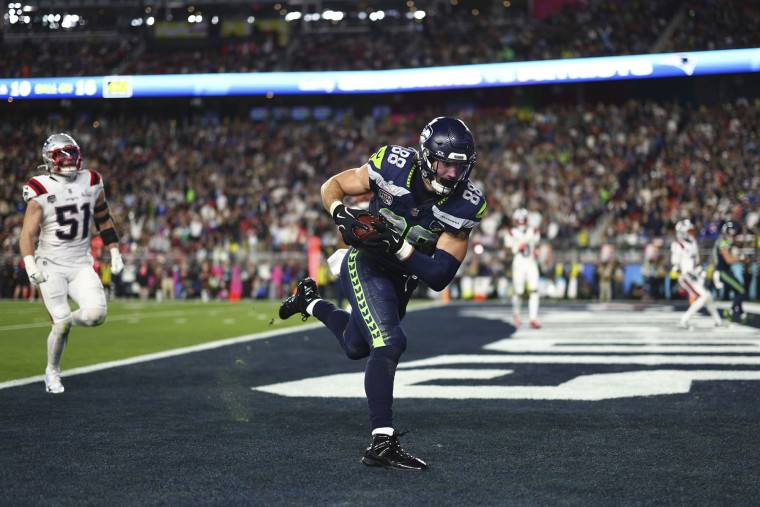
AJ Barner of the Seattle Seahawks catches a touchdown during the fourth quarter of Super Bowl 50.Kevin Sabitus / Getty Images

The move by Congress comes as the Justice Department is investigating the NFL for potential anticompetitive practices. Speaking in April when the probe was disclosed, a government official, who was not authorized to discuss an ongoing investigation by name, said it was “about affordability for consumers and creating an even playing field for providers.”

In March, Sen. Mike Lee, R-Utah, wrote a letter to the Justice Department and the Federal Trade Commission urging them to review whether the NFL’s distribution methods comply with the 1961 law. The FTC has sought comments from the public on the shift of live sports from broadcast channels to streaming services.

The NFL has said 87% of its games are available on free television, and games aired exclusively on cable or streaming services remain available over the air in the home markets of the competing teams.

The league has broadcast or streaming deals with CBS/Paramount+, NBC/Peacock, ABC/ESPN/ESPN+, Fox, NFL Network, Amazon Prime Video, Netflix and YouTube TV. Thursday night games moved to Prime Video in 2022, and the league has since moved a wild-card playoff game, Christmas Day games and a Black Friday game to streamers.

This season, Netflix will stream an opening-week game between the San Francisco 49ers and Los Angeles Rams in Melbourne, Australia, and a Green Bay Packers-Rams game the day before Thanksgiving.