
£10,000 invested? Here’s how to aim for £10,000 of passive income


Here’s a question worth sitting with: could a single £10,000 investment eventually hand you back £10,000 in passive income every year â that’s without lifting a finger? I think it can. And the maths, when you actually run it, is more compelling than most people realise.
Let’s start with the important stuff. This isn’t a get-rich-quick pitch. Those invariably go wrong. The strategy I’m talking about takes time â but that’s precisely the point. Time is the ingredient most investors chronically underestimate.
The building game
If I invest £10,000 today into a portfolio of quality dividend-growth stocks yielding, say, 5%, I’m pocketing £500 in year one. That’s a little underwhelming, I know. It’s less than £50 a month. I imagine most people wouldn’t notice that.
But here’s where compounding starts to do its quiet, relentless work. Invest in growth or dividends, it doesn’t matter, as long as the returns are reinvested.
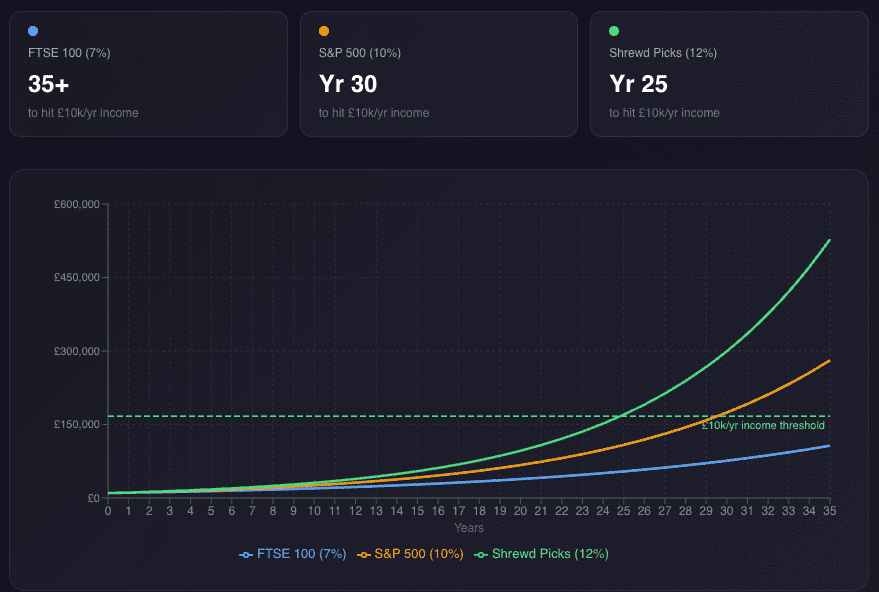
Over 25 years, at a blended total return of 12% annually â not guaranteed, but achievable â that £10,000 swells to roughly £170,000. At a 6% income yield on that pot, we’re talking over £10,000 a year in passive income. From a single starting investment.
Now, 12% annually isn’t the market average â the FTSE 100 has delivered closer to 7%â8% including dividends over the long run. But shrewd stock selection can close that gap.
The S&P 500 has averaged over 10% annually across the past 30 years. Individual compounders â think quality businesses with durable competitive advantages â have done considerably better.
And remember, that could be achieved without adding anything to the principle. Contribute a little each month, and that end figure is reached much quicker.
Where to invest?
Of course, as noted above, we need to know where to invest. Shrewd investments can beat the market.
One such stock could be TBC Bank (LSE:TBCG). It’s a favourite of mine. The bank is one of two large players in Georgia, and also has operations in Uzbekistan â which have proven less smooth.
What draws me in is the valuation. At a forward price-to-earnings of just 5.4 and a price-to-earnings-to-growth (PEG) ratio of 0.5, the market is pricing in very little optimism for a business compounding revenue at over 20% annually. Return on equity sits at 24.1%, the operating margin is a chunky 43%, and the forward dividend yield comes in at 6.35% â covered nearly three times by earnings. That’s a meaningful income stream with room to grow.
The risk? Georgia’s economy leans heavily on service-sector employment. A grey swan worth watching is AI-driven workforce displacement accelerating faster than the labour market can absorb â suppressing consumer credit demand and nudging up bad debts. It’s not my base case, but it’s not nothing either.
Nonetheless, this looks like one of the most compelling investments in the sector. It’s certainly worth considering.
The post £10,000 invested? Here’s how to aim for £10,000 of passive income appeared first on The Motley Fool UK.
Should you invest £1,000 in TBC Bank right now?
When investing expert Mark Rogers has a stock tip, it can pay to listen. After all, the flagship Motley Fool Share Advisor newsletter he has run for nearly a decade has provided thousands of paying members with top stock recommendations from the UK and US markets.
And right now, Mark thinks there are 6 standout stocks that investors should consider buying. Want to see if TBC Bank made the list?
More reading
- Up 291% in 5 years, can this FTSE 250 growth stock keep soaring?
- Dividend yields of 6.3%! Here are 2 stocks to consider buying for passive income
- 2 ISA-boosting stocks that still look cheap in February
- Are these 2 of the best UK stocks to buy in February 2026?
- Why TBC Bank could be the hottest dividend stock in 2026
James Fox has positions in TBC Bank. The Motley Fool UK has no position in any of the shares mentioned. Views expressed on the companies mentioned in this article are those of the writer and therefore may differ from the official recommendations we make in our subscription services such as Share Advisor, Hidden Winners and Pro. Here at The Motley Fool we believe that considering a diverse range of insights makes us better investors.