
How big does your ISA need to be to earn £1,000 a month in passive income?


For UK investors, building a taxâfree passive income through a Stocks and Shares ISA is surprisingly straightforward. With capital gains and dividends shielded from taxes, your stock market investments can grow faster than in a standard Cash ISA, making it a powerful tool for long-term wealth building.
To put that into perspective, the 4% rule implies that to reach a passive income of £1,000 a month, an ISA pot needs to be around £300,000.
Needless to say, that is not pocket money for most people and it raises the question of how you can realistically get there.
Please note that tax treatment depends on the individual circumstances of each client and may be subject to change in future. The content in this article is provided for information purposes only. It is not intended to be, neither does it constitute, any form of tax advice. Readers are responsible for carrying out their own due diligence and for obtaining professional advice before making any investment decisions.
Crunching the numbers
Starting from scratch, contributing £500 a month and gradually increasing to £650 over 20 years, an 8% annual return pushes the ISA pot to the £300k milestone. The chart below highlights this growth and puts it in perspective compared with a Cash ISAâs projected 4% return.
The same chart demonstrates how slightly higher returns can make a difference. By adding just 2% more to your annual return, you reach £300k in 17 years, showing the real power of compounding over time.
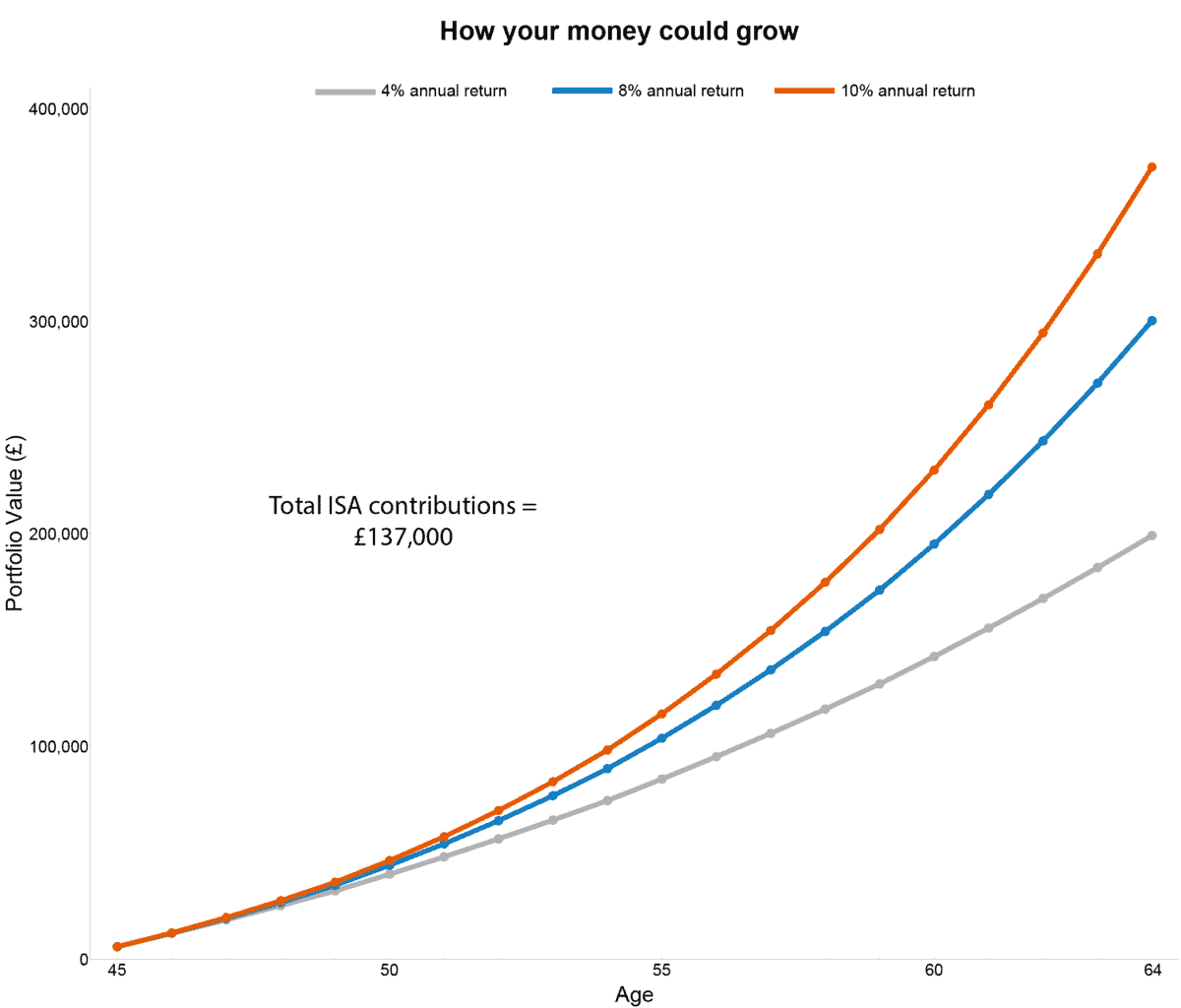
Chart created by author
This is where stock picking comes in. It carries higher risk and demands discipline, diligence, and research. However, it can unlock market-beating returns and get you to your passive income goal faster.
Spotting an opportunity
One sector I believe is set for a bright future over the next several years is oil and gas, and BP (LSE:BP.) looks like a business well positioned to thrive.
The oil market has been anything but boring recently. Brent crude has surged to over $90 a barrel amid escalating geopolitical tensions in the Middle East. Many investors may assume this rally is short-lived, but I see a deeper story.
For too long, oil prices had sunk too low. Rig counts in the all-important Permian basin fell sharply, as $55 oil made drilling uneconomical for many US shale producers. Production was declining, and sentiment toward the sector remained bearish.
BP, however, is in a much stronger position to profit from rising prices. Following a strategic reset last year, the company has been laser-focused on growing its upstream business. In 2025, it added 150,000 barrels per day from six new projects.
Volatile oil prices are inevitable, but the risks extend beyond commodities. Regulatory changes, project delays, and operational challenges could affect earnings and dividend sustainability.
Building a reliable income stream
I think analysts have overstated the narrative that oil and gas are in permanent decline. Global demand remains strong. Companies with tangible assets and disciplined management, like BP, benefit from higher prices and steady production.
Dividends are a key attraction for income-focused investors. BPâs payout has grown at a compound annual growth rate of over 11% in the past five years. Strong free cash flow consistently supports it. Today, the yield sits at 5%.
Paid tax-free in a Stocks and Shares ISA, this dividend can compound steadily. It can help build a £300,000 ISA pot and generate £1,000 a month in passive income.
By taking a long-term view and making regular contributions to resilient, cash-generating businesses, investors can reach their passive income goals faster. Oil and gas, often portrayed as declining, remains central to the global economy. It shows how long-term strategies can support steady income growth.
The post How big does your ISA need to be to earn £1,000 a month in passive income? appeared first on The Motley Fool UK.
Should you invest £1,000 in BP p.l.c. right now?
When investing expert Mark Rogers has a stock tip, it can pay to listen. After all, the flagship Motley Fool Share Advisor newsletter he has run for nearly a decade has provided thousands of paying members with top stock recommendations from the UK and US markets.
And right now, Mark thinks there are 6 standout stocks that investors should consider buying. Want to see if BP p.l.c. made the list?
More reading
- Are BP shares a slam-dunk buy as oil prices rocket â or is there a hidden danger?
- The BP share price is back above 500p â but is there more to come?
- The BP and Shell share price are soaring today â are we looking at another massive spike?
- Iâve bought these 3 brilliant dividend stocks to target a high and rising monthly ISA income
- I asked ChatGPT for its top 5 FTSE 100 stocks to buy for March 2026
Andrew Mackie has positions in Bp P.l.c. The Motley Fool UK has no position in any of the shares mentioned. Views expressed on the companies mentioned in this article are those of the writer and therefore may differ from the official recommendations we make in our subscription services such as Share Advisor, Hidden Winners and Pro. Here at The Motley Fool we believe that considering a diverse range of insights makes us better investors.