Author

admin

Browsing

When the U.S. men’s national soccer team plays at home, its most loyal fans traditionally sit right behind a goal to cheer on the team or intimidate the opposition.

But when the Americans kick off a once-in-a-generation World Cup in Southern California next week, many of those die-hard supporters may be harder to hear because FIFA seated them in the “nose bleeds,” according to a major U.S. fan group.

“These are the worst tickets that I’ve ever seen out of the five World Cups I’ve been to,” American Outlaws President Brian Hexsel said in a phone interview.

FIFA’s World Cup ticketing rollout has faced withering criticism for months, particularly for its sky-high prices. There have also been allegations that some ticket buyers got worse seats than expected, sparking investigations in New York and New Jersey.

In the blowback, soccer’s global governing body announced a small allotment of $60 tickets for each of the tournament’s 104 matches.

FIFA didn’t immediately comment for this article.

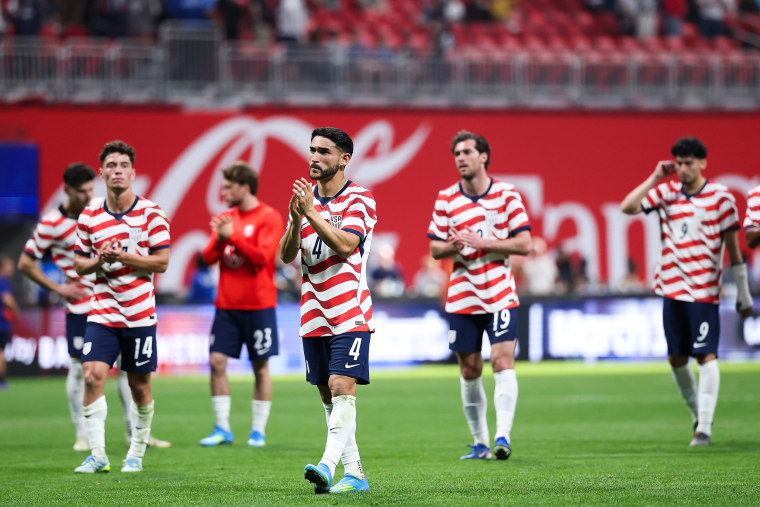
Cristian Roldan, center, and the U.S. team applaud fans after their loss to Belgium at Mercedes-Benz Stadium on March 28.Kevin C. Cox / Getty Images

Participating member associations, including U.S. Soccer, would manage “the selection and distribution process,” said FIFA, which emphasized it was asking the associations to “ensure that these tickets are specifically allocated to loyal fans who are closely connected to their national teams.”

The American Outlaws are such fans. The organization says it has more than 200 chapters worldwide sharing one goal: cheering on U.S. Soccer’s teams. The group travels to matches with hand-painted banners, a giant American flag, drums and organized chants — all of it typically on display right behind the net.

But this summer, American Outlaws members with $60 tickets will be in upper decks at each of the team’s three group stage matches, Hexsel said. That seating arrangement means some of the most fervent fans will be physically farther from the pitch, potentially making it harder for players to hear their shouts.

Hexsel said U.S. Soccer told him Monday that the $60 seats will be in sections 302 through 310 for the team’s first match against Paraguay at Los Angeles County’s SoFi Stadium, sections 310 through 315 in Seattle’s Lumen Field for the second match against Australia and section 426 for the third match back at SoFi against Turkey — putting fans even higher than they’d be seated for the first match.

U.S. Soccer told NBC News the $60 tickets are in sections 306 through 310 for the Paraguay match, sections 302 through 304 for the Australia match and sections 426 through 431 against Turkey. It didn’t provide further comment.

When the tickets started landing in people’s accounts Monday night, “my phone just blew up,” Hexsel said. “Everybody was pissed.”

It’s not clear whether fan groups for the World Cup’s other competing countries have been affected in the same way.

Juan Felipe Garay, coordinator of Colombia’s biggest supporters’ group, Fiebre Amarilla, told NBC News the group doesn’t yet know where its $60 seats will be for Colombia’s matches.

But Hexsel said that without question, for the American die-hards, a World Cup in their own backyard now “does not feel like we are playing in the U.S.”

South Florida superfan Burak, who asked that his last name not be published for privacy, told NBC News on Monday night that a ticket in the “400s” showed up in his account for the third U.S. match.

Burak said he laughed with his wife about the situation and hadn’t expected better seats. He prefers being high up at a match when he’s trying to “read the play.” But, he said, watching is secondary to making an impact when you’re in the supporters’ section.

“If you’re up at nosebleed 400s, your reaction doesn’t even matter. No one’s going to hear, see or notice,” he wrote in a text message.

Another U.S. fan, Gabriel Miguel, said, “I thought it could be worse.”

Miguel scored $60 tickets to the opening U.S. match against Paraguay. He’ll be in section 308 and said he’s “mostly grateful” just to be in the building.

“I would love to have been down in the lower action, but I mean, 300s is perfectly fine, especially for that price.”

American supporter Logan Pedersen said, “We could have been higher up … not by far.”

Pedersen said in a phone interview that he got “the golden ticket,” getting to see the opening U.S. match at such a relatively low cost. He’s “just glad to be in the stadium,” but he also said FIFA’s ticketing “process has been a nightmare.”

“It’s still super disappointing from FIFA that they’re not at least designating a section for, you know, 500 fans from each team directly behind the goal. I think it’s a huge loss for the atmosphere that’s gonna go on in the stadium,” he said.

Hexsel said of the seating arrangements, “It just means we gotta bring more drums and more noise to show the team that … we still showed up.”

“FIFA could have just said: ‘Hey … it’s 300, it’s 200. Yeah, it’s a little bit more than what you paid in Qatar, but you guys have a block of seats where you’ve always had a block of seats,’ and people would have paid it.”

Burak said by text message: “I’m just glad I can at least go to some games with the supporter price. I accept my small guy status. If we had a strong community, I’d be all about boycotting the WC all together. But that’s not how people are, that will never happen. And Fifa is feeding off of that. They know someone will show up.”

Said Miguel: “I’m happy to be going, at least, and it’s more like memories than anything. Could it be better? Of course. But … they dropped the ball from the beginning with this. It’s … nothing surprising at this point.”
Growing up in South Florida, Jozy Altidore heard a lot of Spanish playing soccer with local kids and at home from his Dominican grandmother. As a teenager, he went to play for Villarreal, in the Castellón part of Spain, an area that isn’t that touristy. His coach and teammates mostly spoke Spanish. Along the way, Altidore picked up the language.

“A lot of people look at me like, ‘What? You speak Spanish?’” Altidore told NBC News.

It will come in handy this summer, when Altidore serves as a World Cup commentator for Telemundo, the games’ official Spanish-language network. Altidore has no experience in broadcasting, and he admits that his Spanish is just OK. But he saw the World Cup was coming to North America, and he didn’t want to be left on the sidelines.

“It’s the biggest, most historical World Cup we’ve had,” Altidore said. “For me, it was a good opportunity to stay involved, be a part of the World Cup.”

But what about his Spanish? “I can get by,” he said. “I thought, ‘What a cool challenge.’ I think you want to challenge yourself, in the things that you’re doing, always.”

Plus, he’ll get to see the Telemundo broadcast up close, the excitement of it, which is a stark contrast to the English-language telecasts, particularly the “goal” calls from the announcer Andrés Cantor. “I always wondered, how does he do that in one breath?” Altidore said. “This guy goes just the whole time. I can’t wait to see the legend in action.” (Telemundo and NBC News share a parent company, NBCUniversal.)

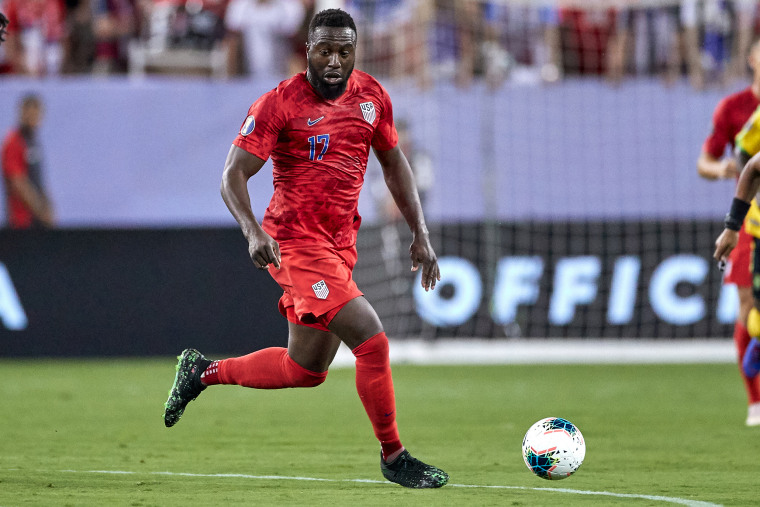
Altidore during the Gold Cup semifinal match between the U.S. and Jamaica in Nashville, Tenn., on July 3, 2019.Robin Alam / Icon Sportswire via Getty Images file

Altidore will be offering analysis and insight on Team USA’s games not far removed from his own time playing for the team. He is considered one of the best American players of the last two decades, a striker who scored 42 goals in 115 appearances. He helped the U.S. make it to the 2010 and 2014 World Cups, though he got injured during the latter tournament. He played with a few members of the 2026 roster, including Christian Pulisic.

Altidore told NBC News he has a rose-colored view of the current team. “I’m optimistic,” he said. “I’m bullish. I think this team can win the World Cup. I really do. I think they have the talent. And I’m so excited for them to get their flowers.”

Altidore understands how that sounds: Team USA? Winning the World Cup? But he pointed to past examples of host countries making deep runs in the tournament: South Korea reaching the semifinals in 2002, and Germany doing the same in 2006. Colombia also reached the quarterfinals in 2014, when the World Cup was held in neighboring Brazil.

With this World Cup being held on home soil, maybe “we’re able to push our team to a bit of a better performance than we have historically,” Altidore said.

He didn’t just mean the players — he meant the fans, too. “Can we show up in numbers in a way that, from the players’ arrival, they feel the emotion, they feel the enthusiasm, they feel the camaraderie?” Altidore said. “And we can push them on to play a little bit above themselves, to play a little bit above what we’ve seen already.”

You can sense his excitement. As a media member, Altidore will have to now learn to balance his rooting interests with offering clear-eyed analysis. “For me, it’s really getting behind these guys, applauding them for how far they’ve now taken the flag and where they’ve brought it,” he said. “But at the same time, it’s not all rainbows. You’ve got to be critical of guys, and you have to obviously critique their performances.”

Altidore was first introduced to soccer in 1994, the last time the U.S. hosted the World Cup, when he was just a young boy. His father recorded games on VHS tapes. He imagines lots of families will do the same this summer, three decades later, albeit with updated technology.

“They’re going to get exposed to soccer in a wonderful way for the first time, and it’s going to birth soccer players, it’s going to birth soccer fans, soccer enthusiasts,” Altidore said.

He’ll be doing his part, by showing his enthusiasm on the Telemundo broadcasts. “It’s more than just X’s and O’s in my opinion,” Altidore said. “This is a very good opportunity to continue growing the game for another 30, 40 years to come.”

NFL Commissioner Roger Goodell has been invited to testify before Congress as the league faces increasing federal scrutiny about its broadcast deals and its recent practice of airing games on paywalled streaming services.

Rep. Jim Jordan, R-Ohio, the chairman of the House Judiciary Committee, sent a letter to the commissioner Monday requesting his appearance at a hearing June 10 examining the league’s TV deals and their compliance with the Sports Broadcasting Act of 1961.

The 65-year-old law grants professional sports leagues limited antitrust immunity, allowing them to pool their media rights and negotiate as a single entity while protecting them from antitrust lawsuits.

The law applies only to broadcast networks. Courts have ruled in the past that it does not apply to other media, including cable, satellite and streaming. There has been bipartisan sentiment in favor of updating the law, and President Donald Trump has been among the critics of the NFL’s embrace of streaming.

According to Jordan’s letter, the hearing next week will “examine the extent to which the antitrust exemption created by the SBA has been used by the professional sports leagues to harm consumers and whether potential legislative remedies may be needed to address that harm.”

An NFL spokesman did not immediately respond to a request for comment on the letter.

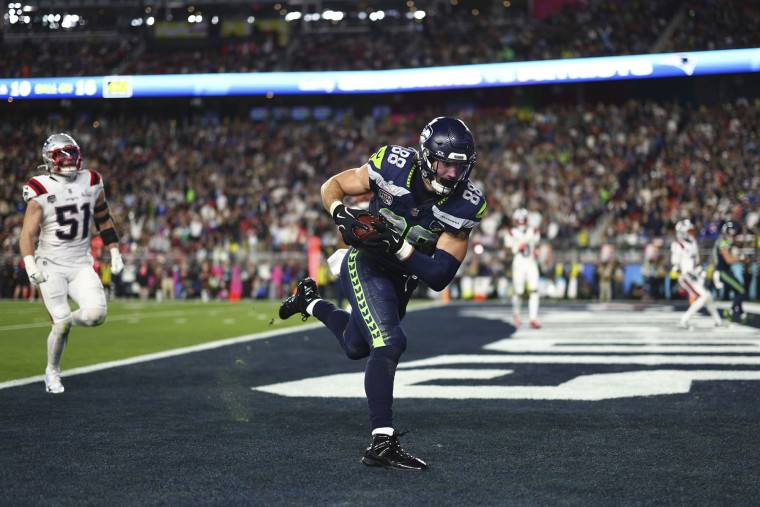
AJ Barner of the Seattle Seahawks catches a touchdown during the fourth quarter of Super Bowl 50.Kevin Sabitus / Getty Images

The move by Congress comes as the Justice Department is investigating the NFL for potential anticompetitive practices. Speaking in April when the probe was disclosed, a government official, who was not authorized to discuss an ongoing investigation by name, said it was “about affordability for consumers and creating an even playing field for providers.”

In March, Sen. Mike Lee, R-Utah, wrote a letter to the Justice Department and the Federal Trade Commission urging them to review whether the NFL’s distribution methods comply with the 1961 law. The FTC has sought comments from the public on the shift of live sports from broadcast channels to streaming services.

The NFL has said 87% of its games are available on free television, and games aired exclusively on cable or streaming services remain available over the air in the home markets of the competing teams.

The league has broadcast or streaming deals with CBS/Paramount+, NBC/Peacock, ABC/ESPN/ESPN+, Fox, NFL Network, Amazon Prime Video, Netflix and YouTube TV. Thursday night games moved to Prime Video in 2022, and the league has since moved a wild-card playoff game, Christmas Day games and a Black Friday game to streamers.

This season, Netflix will stream an opening-week game between the San Francisco 49ers and Los Angeles Rams in Melbourne, Australia, and a Green Bay Packers-Rams game the day before Thanksgiving.

Major League Baseball owners made their long-expected salary cap proposal to the players’ association on Thursday, a system the union has vowed never to accept, setting the sides on course for a confrontation that threatens the 2027 season and perhaps beyond.

Baseball owners hadn’t proposed a firm cap since 1994. Their effort prompted a 7 1/2-month strike that forced the cancellation of the World Series for the first time in 90 years.

MLB’s proposal would cap spending in 2027 at $245.3 million, using figures for luxury tax payrolls that include benefits and the pre-arbitration bonus pool, and establish a payroll floor of $171.2 million. The Los Angeles Dodgers, baseball’s biggest spenders, had a $415.2 million payroll on opening day this year — around $170 million over the proposed cap.

Owners said they would discuss a phase-in schedule that would give teams like the Dodgers time to comply with the cap and an escrow system with the union as part of a proposed seven-year deal, that all current contracts would remain guaranteed and there would be no prohibition of guaranteed contracts under the cap system.

MLB said it would centralize local media revenue from the 30 teams equally and give players a 50-50 split as part of a proposal that would eliminate the current revenue-sharing plan among the clubs.

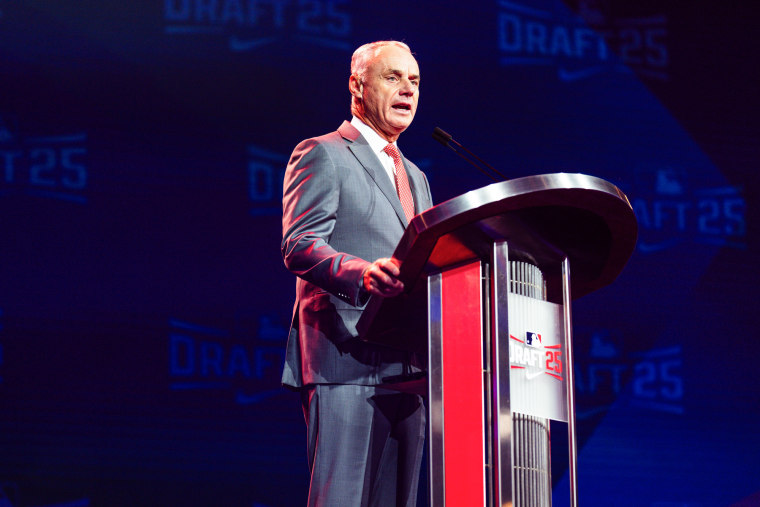
Major League Baseball Commissioner Rob Manfred.Matthew Grimes Jr. / Atlanta Braves via Getty Images file

“Our salary cap and floor proposal levels the playing field while sharing baseball revenue with the players 50/50 as we grow the game together,” MLB spokesman Glen Caplin said in a statement. “Further, by sharing media revenue equally as part of our proposal, we can address another top fan concern of local TV blackouts.”

Baseball’s current five-year deal, agreed to in March 2022 after a 99-day lockout, expires Dec. 2. While a lockout next winter is expected, talks are not likely to intensify until late February or early March 2027, when the possibilities of losing regular-season games and revenue near. If regular-season games are lost, negotiations may become a standoff of which side can tolerate the most economic loss.

Based on 2026 opening day figures, eight teams would have to cut payroll to get under the cap. The teams over are the two-time reigning World Series champion Dodgers, New York Mets ($379.2 million), New York Yankees ($339.6 million), Toronto ($319.5 million), Philadelphia ($315.2 million), Boston ($263.7 million), San Diego ($260.1 million) and Atlanta ($247.9 million).

Twelve teams would be required to increase payroll by a total of $617 million based on 2026 numbers: Miami ($81.8 million), Cleveland ($95.7 million), Tampa Bay ($108.2 million), the Chicago White Sox ($108.6 million), St. Louis ($114.4 million), Washington ($119.1 million), Pittsburgh ($122.6 million), Minnesota ($125.6 million), Milwaukee ($130.9 million), the Athletics ($139.2 million), Colorado ($142.2 million) and Cincinnati ($148.8 million).

Owners and the union agreed to a luxury tax in 2003 designed to slow spending, but teams feel it has had little or no impact on the Dodgers and Mets in recent years. The last small-market MLB club to win a World Series was Kansas City in 2015, although Cleveland, Tampa Bay and Milwaukee all lead their divisions as of Thursday, while the Mets and Red Sox are in last place.

MLB said its revenue has grown by 247% since 2003 and player payroll has increased by 149% in that span.

Management gave the union its latest plan during a bargaining session at the commissioner’s office, one day after the union made its economic proposal. Owners say a cap is needed to improve competitive balance and restrain wealthy teams from assembling starrier rosters than their smaller-market brethren.

Players want expanded free agency and salary arbitration rights along with almost doubling the major league minimum, increasing the money high-revenue teams share with the less-wealthy clubs and establishing penalties for teams that drop below payroll floors.

Aaron Judge of the U.S. leads teammates onto the field before game against Venezuela in the World Series of Baseball in Miami on March 17.Megan Briggs / Getty Images file

Other U.S. major sports leagues operate under a cap. The NBA had a cap in its initial season in 1946-47, then dropped that and began its modern version in 1984-85. NFL players and owners adopted a cap for the 1994 season, and the NHL did so in 2005-06 after a lockout wiped out the entire 2004-05 season.

The Dodgers shattered MLB’s spending record with a combined $515 million in payroll and luxury tax last year en route to their second straight World Series title. Los Angeles’ total was seven times the $68.7 million payroll of the Marlins, the lowest-spending team, and more than the payrolls of the bottom six clubs combined.

Players say a cap would hurt them and enrich owners, and they say they will never agree to one. Without a cap, MLB stars have landed lucrative, guaranteed contracts that outpace what the biggest stars in other U.S. sports leagues make. Juan Soto’s $765 million, 15-year contract with the Mets is believed to be the biggest ever in team sports and is far greater than the largest deals in the NFL (Patrick Mahomes at $450 million over 10 years) and NBA (Jayson Tatum at $314 million over five years).

MLB’s last salary cap proposal in 1994 offered players a 50-50 split of revenue in a system that would have forced teams to maintain payrolls of 84%-110% of the average. Salary arbitration would have been eliminated and the threshold for free agency would have been lowered from six years’ major league service to four — with the provision that a player’s former club could match any offer until he had six years.

MLB’s offer came on June 14 that year, and players struck on Aug. 12. MLB withdrew the cap proposal the following Feb. 6 after pressure by the National Labor Relations Board. The strike ended on March 31 after U.S. District Judge Sonia Sotomayor — now a Supreme Court justice — issued an injunction restoring the work rules of the expired labor contract. Two days later, owners accepted the union’s offer to return to work without an agreement. A deal wasn’t reached until 1997.

The S&P 500 ($SPX) just logged its fifth straight trading box breakout, which means that, of the five trading ranges the index has experienced since the April lows, all have been resolved to the upside.

How much longer can this last? That’s been the biggest question since the massive April 9 rally. Instead of assuming the market is due to roll over, it’s been more productive to track price action and watch for potential changes along the way. So far, drawdowns have been minimal, and breakouts keep occurring. Nothing in the price action hints at a lasting change — yet.

While some are calling this rally “historic,” we have a recent precedent. Recall that from late 2023 through early 2024, the index had a strong start and gave way to a consistent, steady trend.

From late October 2023 through March 2024, the S&P 500 logged seven consecutive trading box breakouts. That streak finally paused with a pullback from late March to early April, which, as we now know, was only a temporary hiccup. Once the bid returned, the S&P 500 went right back to carving new boxes and climbing higher.

New 52-Week Highs Finally Picking Up

If there’s been one gripe about this rally, it’s that the number of new highs within the index has lagged. As we’ve discussed before, among all the internal breadth indicators available, new highs almost always lag — that’s normal. What we really want to see is whether the number of new highs begins to exceed prior peaks as the market continues to rise, which it has, as shown by the blue line in the chart below.

As of Wednesday’s close, 100 S&P 500 stocks were either at new 52-week highs or within 3% of them. That’s a strong base. We expect this number to continue rising as the market climbs, especially if positive earnings reactions persist across sectors.

Even when we get that first day with 100+ S&P 500 stocks making new 52-week highs, though, it might not be the best time to initiate new longs.

The above chart shows that much needs to align for that many stocks to peak in unison, which has historically led to at least a short-term consolidation, if not deeper pullbacks — as highlighted in yellow. Every time is different, of course, but this is something to keep an eye on in the coming weeks.

Trend Check: GoNoGo Still “Go”

The GoNoGo Trend remains in bullish mode, with the recent countertrend signals having yet to trigger a greater pullback.

Active Bullish Patterns

We still have two live bullish upside targets of 6,555 and 6,745, which could be with us for a while going forward. For the S&P 500 to get there, it will need to form new, smaller versions of the trading boxes.

Failed Bearish Patterns

In the chart below, you can view a rising wedge pattern on the recent price action, the third since April. The prior two wedges broke down briefly and did not lead to a major downturn. The largest pullbacks in each case occurred after the S&P 500 dipped below the lower trendline of the pattern.

The deepest drawdown so far is 3.5%, which is not exactly a game-changer. Without downside follow-through, a classic bearish pattern simply can’t be formed, let alone be broken down from.

We’ll continue to monitor these formations as they develop because, at some point, that will change.

Is the market’s next surge already underway? Find out with Tom Bowley’s breakdown of where the money is flowing now and how you can get in front of it.

In this video, Tom covers key moves in the major indexes, revealing strength in transports, small caps, and home construction. He identifies industry rotation signals, which are pointing to aluminum, recreational products, and furnishings. Tom then demonstrates how to use StockCharts’ tools to scan for momentum stocks in emerging leadership groups — see why SGI tops Tom’s list. He ends with a discussion of post-earnings reactions from major names like GOOGL, TSLA, IBM, and LVS. 

And, of course, Tom wraps every idea with clear chart setups you can act on today. 

This video premiered on July 24, 2025. Click this link to watch on Tom’s dedicated page.

Missed a session? Archived videos from Tom are available at this link.

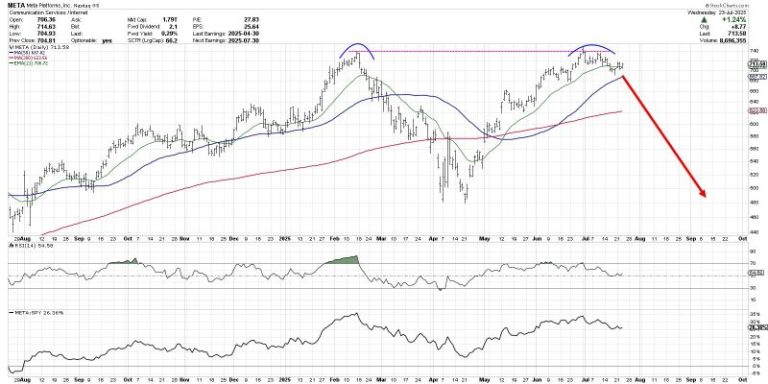
The chart of Meta Platforms, Inc. (META) has completed a roundtrip from the February high around $740 to the April low at $480 and all the way back again.  Over the last couple weeks, META has now pulled back from its retest of all-time highs, leaving investors to wonder what may come next.

Is this the beginning of a new downtrend phase for META?  Or just a brief pullback before a new uptrend phase propels META to new all-time highs?

Today we’ll look at two potential scenarios, including the double top pattern and the cup and handle pattern, and share which technical indicators and approaches could help us determine which path plays out into August.

The double top scenario basically means that the late July retest of the previous all-time high was the end of the recent uptrend phase.  The double top pattern is literally when a major resistance level is set and then retested.  The implication is that a lack of willing buyers means the uptrend is exhausted, and there is nowhere to go but down.

While the 21-day exponential moving average is currently in play for META, I would say that a break below the 50-day moving average could confirm this as the correct scenario.  If that smoothing mechanism does not hold, then the price action would imply less of a pullback and more like the beginning of a real distribution phase.

What is META pulls back but then resumes an uptrend phase, leading META to another new all-time high?  That would result in a confirmed cup and handle pattern, created by a large rounded bottoming pattern followed by a brief pullback.  The key to this pattern is the “rim” of the cup, which sits right at $740 for META.

Given the pullback META has demonstrated so far in July, I would say that a break above the $740 level would basically confirm a bullish cup and handle pattern.  That would suggest much more upside potential for META, as the stock would literally go into previously uncharted territory.

So how can we determine which scenario is more likely to play out?  This is where we need to incorporate more technical indicators into the discussion, as a way to further validate and confirm our investment thesis.

Just to review, I think a break above $740 would confirm a bullish cup and handle pattern.  I would also say that a break below the $680 level, which would represent a move below the 50-day moving average as well as the June swing lows, would basically confirm a bearish double top pattern.

We can also use the Relative Strength Index (RSI) to help determine whether META remains in a bullish trend phase.  During bull phases, the RSI rarely gets below 40, because buyers usually step in to “buy the dips” and keep the momentum fairly constructive.  So if the price would break down, and the RSI would not hold that crucial 40 level, that could mean a bearish outlook is warranted.

Finally, we can use volume-based indicators to assess whether moves in the price are supported by stronger volume readings.  Here I’ve included the Accumulation/Distribution Line, which tracks the trend in daily volume readings over time.  We can see that the high in July resulted in a divergence, as the A/D line was trending lower.  If the A/D line would break below its June and July lows, marked by a dashed red line, that would represent a bearish volume reading for META.

Technical analysis is less about predicting the future, and more about determining the most probable scenarios based on our analysis of trend, momentum, and volume.  I hope this discussion shows how the outlook for META can be easily determined and tracked using the best practices of technical analysis!

RR#6,

Dave

PS- Ready to upgrade your investment process?  Check out my free behavioral investing course!

David Keller, CMT

President and Chief Strategist

Sierra Alpha Research LLC

marketmisbehavior.com

https://www.youtube.com/c/MarketMisbehavior

Disclaimer: This blog is for educational purposes only and should not be construed as financial advice.  The ideas and strategies should never be used without first assessing your own personal and financial situation, or without consulting a financial professional.  

The author does not have a position in mentioned securities at the time of publication.    Any opinions expressed herein are solely those of the author and do not in any way represent the views or opinions of any other person or entity.

Markets don’t usually hit record highs, risk falling into bearish territory, and spring back to new highs within six months. But that’s what happened in 2025.

In this special mid-year recap, Grayson Roze sits down with David Keller, CMT, to show how disciplined routines, price-based signals, and a calm process helped them ride the whipsaw instead of getting tossed by it. You’ll see what really happened under the surface, how investor psychology drove the swings, and the exact StockCharts tools they leaned on to stay objective. 

If you’re focused on protecting capital, generating income, and sleeping well at night while still capturing the upside, this is a must-watch. Discover which charts deserve your attention now, what to ignore, and how to prep for the back half of 2025. 

This video premiered on July 23, 2025. Click on the above image to watch on our dedicated Grayson Roze page on StockCharts TV.

You can view previously recorded videos from Grayson at this link.

Here are some charts that reflect our areas of focus this week at


XLU Leads with New High

Even though the Utilities SPDR (XLU) cannot keep pace with the Technology SPDR (XLK) and Communication Services SPDR (XLC), it is in a leading uptrend. XLU formed a cup-with-handle from November to July and broke to new highs the last two weeks. ETFs hitting new highs are in strong uptrends and should be on our radar.


Metal Mania in 2025

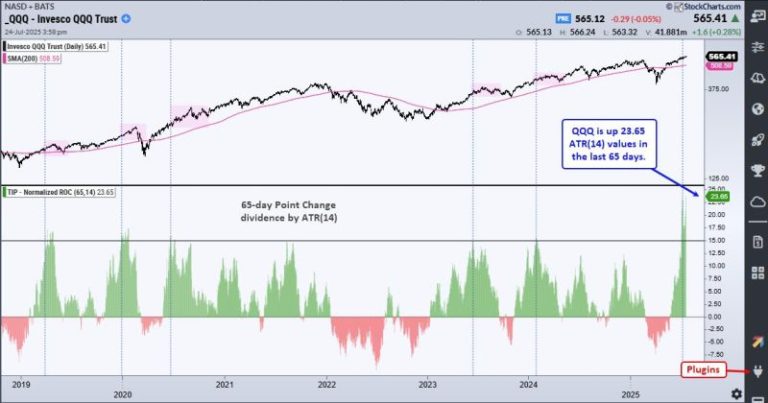
In a tribute to Ozzy, metals are leading the way higher in 2025. The PerfChart below shows year-to-date performance for the continuous futures for 12 commodities. Copper, Platinum and Palladium are up more than 45% year-to-date, while Gold is up 28.38% and Silver is up 35.30%. QQQ is up 10.52% year-to-date, but lagging these metals. The other commodities are mixed.


Multi-Year Highs for Silver and Copper

The next chart shows 11 year bar charts for five metals. Gold broke out in early 2024 and led the metals move with an advance the last 21 months. Silver and copper broke out to multi-year highs. Platinum broke above its 2021 high and Palladium got in the action with an 18 month high. There is a clear message here: metals are moving higher and leading as a group.  


Home Construction Hits Moment of Truth

The Home Construction ETF (ITB) hit its moment of truth as it rose to its falling 40-week SMA. Notice that ITB failed just below this moving average in August 2023. During the 2023-2024 uptrend, the 40-week SMA was more friendly as ITB reversed near this level in October 2023 and June 2024. ITB surged to the falling 40-week SMA in July, but the long-term trend is down and this area could be its nemesis.

Thanks for Tuning in!

See TrendInvestorPro.com for more


Tartisan Nickel Corp. (CSE: TN,OTC:TTSRF) (OTCQX: TTSRF) (FSE: 8TA) (‘Tartisan’, or the ‘Company’) is pleased to provide an update on the Phase 1 diamond drill program at the Company’s Kenbridge Nickel-Copper-Cobalt Project, Sioux Narrows, Northwestern Ontario. The Phase 1 drill program was designed to test the on strike and down dip potential for additional nickel sulphide mineralization to enhance the size and grade of the Kenbridge Deposit.

A total of 3,191m of drilling has been completed to date. The first 4 drill targets have been completed (drill holes KB26-207, KB26-208, KB26-209 and KB26-210 outlined on Figure 1). Samples were delivered to AGAT Labs in Thunder Bay for analysis.

Reported in this release are the results from the 4th hole KB26-210. Results from the hole confirm both A and B zones were intersected as outlined in the Table 1 below. Zone A was intersected from 762.4 to 787.0m drill depth and returned 0.71% Ni, 0.56% Cu over 24.6 metres including 6.1m of 1.17% Ni, 1.45% Cu from 762.4 to 768.5m drill depth and 2.0 m of 1.73% Ni, 0.31% Cu from 774.5 to 776.5m drill depth. Zone B was intersected from 800.2m to 806.0m drill depth. Results were 0.27% Ni, 0.24% Cu over 5.8 metres. Drill core intersection widths are estimated to be between 65 and 80% true width.

Fig 1: Long section of Kenbridge deposit showing drilling targets. Completed or holes in progress are outlined in red circles.

To view an enhanced version of this graphic, please visit:
https://images.newsfilecorp.com/files/1492/288216_d63210af3456385c_002full.jpg

Mark Appleby, CEO of Tartisan Nickel Corp., stated, ‘The KB26-210-hole result represents a significant high-grade intercept. We are very encouraged to see the wider intersection as the deposit appears to now flare outwards at depth. Intersecting 24.6 metres of 0.71% Ni and 0.56% Cu including higher grade portions (1.17% Ni, 1.45% Cu over 6.1m and 1.73% Ni, 0.31% Cu over 2.0m) confirms continuity of significant nickel-copper mineralization in this system. These results will strengthen our ability and confidence in upgrading our resource and in the project’s overall potential. While we have now taken a brief pause for spring break up, the company will introduce Borehole EM down the drill holes completed in Phase 1 and commence Phase 2 drilling this spring. We look forward to drilling below the existing shaft bottom to test for the depth extension to the deposit shortly.’

Table 1: Highlight intervals (* denotes hole reported in this release)

To view an enhanced version of this graphic, please visit:
https://images.newsfilecorp.com/files/1492/288216_table1.jpg

The Kenbridge Property is in the Kenora Mining District, Sioux Narrows, Ontario, Canada with all-season road access. The Kenbridge Deposit has an existing shaft to a depth of 2,042 ft (622 m), with level stations at 150 ft. (45 m) intervals below the shaft collar and two levels developed at 350 ft (107 m) and 500 ft (152 m) below the shaft collar.

Surveyed Hole Locations (Coordinates in UTM zone 15)

To view an enhanced version of this graphic, please visit:
https://images.newsfilecorp.com/files/1492/288216_table2.jpg

Qualified Person

The technical information in this news release has been prepared in accordance with Canadian regulatory requirements as set out in NI 43-101 and reviewed and approved by Dean MacEachern, P. Geo., an Independent Consultant to the Company and a Qualified Person as defined by NI 43-101.

QA/QC

Sample QA/QC procedures for Tartisan have been designed to meet or exceed industry standards. Drill core is collected from the diamond drill and placed in sealed core trays for transport to on-site sampling and core cutting facilities. The core is logged and samples taken from 0.3m to a maximum sample length of 1.5m. The core samples are split with a diamond blade saw with continuous running water, half of the sample is sent for lab testing, and the remaining half core is left in the core box for record or further sampling. The core samples are bagged in heavy plastic bags with 6 samples being placed into a rice bag for transport to AGAT Laboratories in Thunder Bay, ON or Calgary, AB for assay. Samples are submitted in batches of 50. 100g blind certified reference materials (CRMs) from CDN Resources, as well as, duplicates and blank samples are systematically inserted by the Company into the sample stream with reference to the mineralization in the sampled rock and analyzed as part of the Company’s quality assurance/quality control protocol, as well, AGAT labs implements their own quality control testing by inserting their own CRMs and Blanks in the sample stream for accredited testing.

All drill core samples were prepped and analyzed at AGAT Laboratories in Thunder Bay, Ontario or shipped to Calgary for testing. An ISO/IEC 17025 2017 certified independent laboratory from organizations like the Standards Council of Canada (SCC), the Canadian Association for Laboratory Accreditation (CALA), ANSI National Accreditation Board (ANAB) and the American Association of Laboratory Accreditation (A2LA). They maintain accreditations across their facilities in Alberta, Saskatchewan, Ontario, Nova Scotia, Newfoundland, Quebec and internationally.

NQ-diameter sawed half-core samples from the drilling program were securely sent by Tartisan Nickel Corp’s geologists to AGAT Laboratories Ltd. (AGAT), with sample preparation in Thunder Bay, Ontario, and analysis in Thunder Bay, Ontario & Calgary, Alberta. Samples were processed for Au, Pt and Pd analysis by 50-gram fire assay with ICP-OES finish and for four acid digestion, multi-element analysis by inductively coupled plasma & mass spectrometry (ICP OES + MS). AGAT sample preparation and laboratory analysis procedures conform to requirements of ISO/IEC Standard 17025 guidelines and meet the requirements under NI 43-101 and CIM best practice guidelines. AGAT Laboratories is independent of Tartisan Nickel Corp.

Samples were dried and crushed to 2 mm, from which a 250 g sub-sample split was then pulverized to 85% passing a 75 micron sieve. Following preparation, assays were determined by the ICP OES method. A 0.25 g aliquot of the prepared pulp was digested in a 4-acid solution consisting of hydrochloric, nitric, perchloric and hydrofluoric acids. 4-acid is a near total digest and only the most highly resistant minerals are not dissolved. The resulting solution was analyzed via ICP-MS and ICP-ES for 8 elements and was corrected for inter-element spectral interferences. Lower detection limits for this procedure are 0.01 ppm for nickel, 0.01 ppm for copper, 0.01 ppm for cobalt, 0.01 ppm for platinum, 0.01 ppm palladium, 0.01 ppm silver and 0.01 ppm for gold.

Samples with initial results beyond the upper detection limit of the ICP OES method were analyzed by (201-071) 4 acid digest – Metals Package, ICP-OES/ICP-MS finish (CGY). The thresholds are >1% for nickel, copper and cobalt. AGAT Laboratories employs internal quality control standards, duplicates and blank samples at set frequencies. Tartisan Nickel Corp. stores all its drilled core on-site and takes pride in its facilities and strives for excellence in its QA/QC procedures.

About Tartisan Nickel Corp.

Tartisan Nickel Corp. is a Canadian-based critical minerals exploration and development company which owns, the Kenbridge Nickel-Copper Project near Sioux Narrows, Northwestern Ontario, the Sill Lake Silver Project near Sault Ste. Marie, Ontario as well as the Night Danger Turtle Pond Project near Dryden, Ontario.

Tartisan Nickel Corp. common shares are listed on the Canadian Securities Exchange (CSE: TN,OTC:TTSRF) (OTCQX: TTSRF) (FSE: 8TA). Currently, there are 152,215,641 shares issued and outstanding (156,287,356 fully diluted).

For further information, please contact Mark Appleby, President & CEO, and a Director of the Company, at 416-804-0280 (info@tartisannickel.com). Additional information about Tartisan Nickel Corp. can be found at the Company’s website at www.tartisannickel.com or on SEDAR+ at www.sedarplus.ca.

This news release may contain forward-looking statements including but not limited to comments regarding the timing and content of upcoming work programs, geological interpretations, receipt of property titles, potential mineral recovery processes, etc. Forward-looking statements address future events and conditions and therefore involve inherent risks and uncertainties. Actual results may differ materially from those currently anticipated in such statements.

The Canadian Securities Exchange (operated by CNSX Markets Inc.) has neither approved nor disapproved of the contents of this press release.

To view the source version of this press release, please visit https://www.newsfilecorp.com/release/288216

News Provided by TMX Newsfile via QuoteMedia

This post appeared first on investingnews.com